
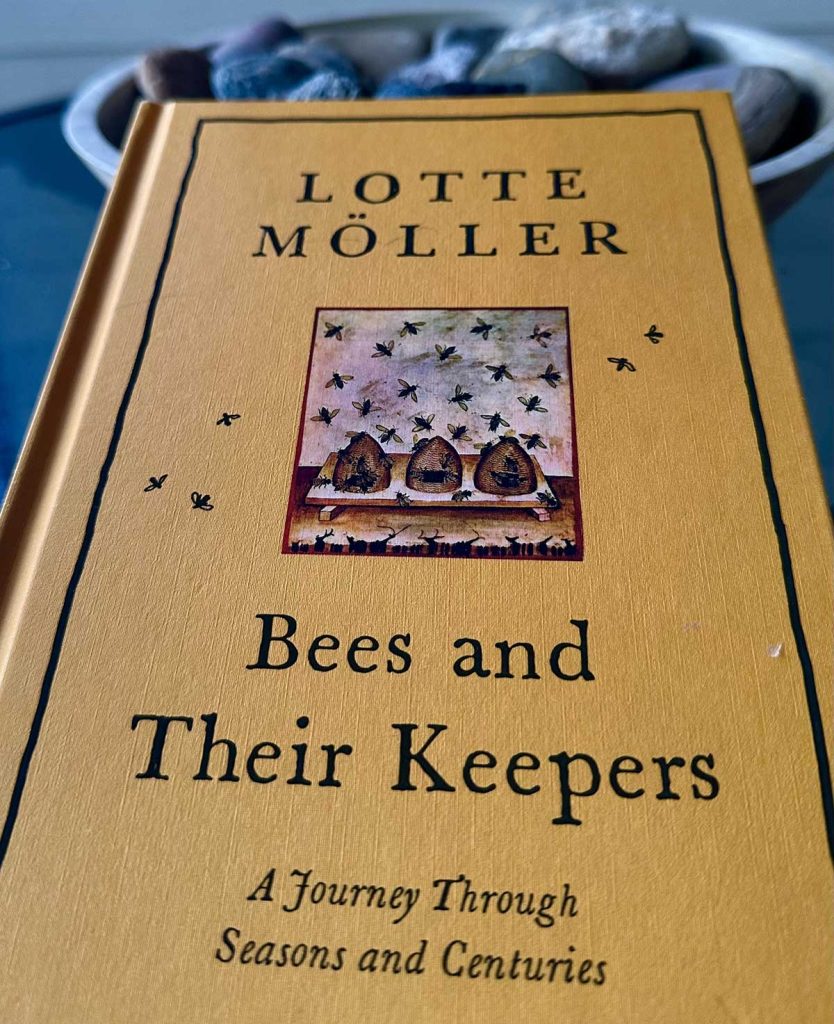
Lotte Möller’s Bees and Their Keepers was a recent gift that I enjoyed consuming. The book was published in Swedish in 2019 with the English translation out the next year.
Long fascinated by honeybees, the book was a reminder of their wonderment along with new insights and a more global perspective. It brought back memories of growing up in a beekeeping family.
Using a bladed tool to snatch a piece of honey-filled comb from the hive, lifting my veil for an instance and slipping its sweetness to my mouth without a bee joining in was just one pleasing recollection.
My travel-filled adult life and small-yard living hasn’t been conducive to beekeeping. So I seek out local beekeepers to stay stocked in honey eaten on nearly a daily basis.
Möller’s discussion of ongoing debates among beekeepers — leaning into folk wisdom, scientific evidence or some mixture — reminded me of my youthful attendance at monthly meetings of the Chattanooga Area Beekeepers Association.
The group’s annual weeklong “short course on beekeeping” and ribbon-seeking submissions to the honey exhibit at the Hamilton County Fair each fall brought more discussions if not debates on methods and honey varieties.
The latter is always subjective and influenced by one’s own crop: tupelo, clover, orange blossom (which had to be brought in from well below Appalachia).
The Swedes boast of their “lime” (Linder tree) honey while the Brits hail heather honey as the golden standard, I learned.
Sourwood was considered the Cadillac of honey from the beekeepers I knew, most of whom couldn’t afford a real Cadillac.
My dad and uncle put 10 hives on a friend’s commercial pimento pepper farm near Monteagle, Tenn. I enjoyed the Saturdays we’d go there to tend the bees.
We brought some good honey back each year. My dad wouldn’t call it “robbing” the bees since we left enough for their winter needs.
“Just taking my part of the investment,” he would say.
He especially enjoyed stumping the experts — usually county extension agents or other agriculturalists — who prided themselves in identifying the producing plants by tasting a mere spoonful of honey.
And, no, the pepper blossom didn’t yield a pepper-tasting honey. But a good flavor unfamiliar to most.
For a long time, honeybee colonies have been considered a laboratory for societal lessons — often with religious overtones. And, often, those lessons have been wrong.
Authoritarian church leaders have a long and continuous history of deeming someone a heretic rather than recalculating their own misunderstandings of reality even in the face of overwhelming evidence to the contrary.
Such was the case, Möller notes, when the waxy theological argument for a male monarch overlording his workers — with the bee colony as an example of such divine order — began to melt.
“Theology and monarchy were ranged against science and the Enlightenment,” he writes.
Scientific evidence from more than one corner arose proving beyond a doubt that queens rule the world of bees.
The 17th-century Dutch naturalist Jan Swammerdam was the first to study the anatomy of bees under a microscope removing any doubt about the gender of the queen, workers and the fat male drones.
However, as is often the case, religious authorities were largely more concerned with retaining power than seeking truth.
“Human society was steeped in Christian belief, and the bee colony was a divinely ordained model of excellence,” said Möller of yet another oversold theological error.
For in the same way scientific observations of a stationary sun and rotating earth by Nicolaus Copernicus and Galileo Galilei could not be stomped out by priestly feet, these bee-lieving religious leaders faced the stinging reality that a female ruled the hive.
“But those who found this difficult to swallow might nevertheless devalue her status and appearance.” writes Möller.
For example, Englishman John Keys, reflecting the fragile faith and ego of many males today, demeaned this marvelous creature as being awkward.
Damage done in the name of the Christianity by those who fight unnecessary battles between faith and science — as if all truth is not fully truth and worthy of reconsideration — is immense and ongoing.
Danish writer Jørgen Steen Nielsen, as quoted by Möller, offered a healthier perspective of bee and human cultures:
“We fancy ourselves the most intelligent of creatures. But intelligence encompasses many different things, including the ability to ensure a community’s survival and its stability by employing a capacity to listen, collaborate and focus on the common good.”
Then Nielsen insightfully adds: “If we fail to learn more of these qualities from the bees, who have far greater experience, we will lose first the bees and then ourselves.”
What a needed word, especially for the religiously attuned who would do well to focus more on the common good — rooted in love of neighbor — than a fear-driven, self-serving sense of being right and in control.
At least that’s how Jesus called his followers to live — producing goodness like the sweet taste of nature’s pure delight: honey.
John D. Pierce is director of the Jesus Worldview Initiative (jesusworldview.org), part of Belmont University’s Rev. Charlie Curb Center for Faith Leadership.